







1. History
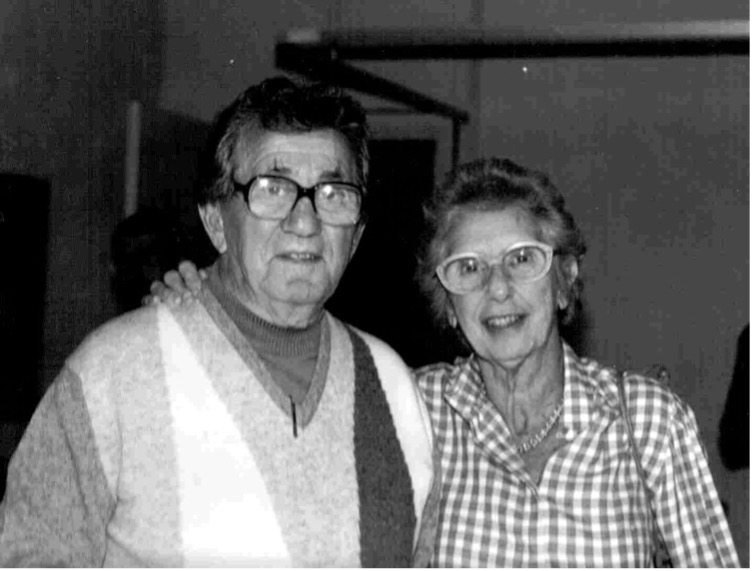
The Bobath Concept was conceived and developed in the early 1940s by Dr Karel and Mrs Berta Bobath who came to Great Britain as Jewish refugees from Germany in the 1930s. They taught the Bobath Concept as a clinical treatment approach for adults with stroke, and for children with cerebral palsy, from their London treatment centres for almost 5 decades. They took their post graduate courses to the United States, where it subsequently became known as Neuro-Developmental Therapy (NDT) and were invited to lecture extensively in Europe. They wrote many papers and books and were showered with National and International honours.

The European Bobath Tutors’ Association (EBTA) was founded in 1971 by five German speaking countries, as an association of Teaching Centres (TC). The attendees were medical doctors, physiotherapists, occupational therapists, and speech & language therapists.
Presidents were elected at meetings which took place every two years. Dr Karel Bobath was the first President elected in Innsbruck, followed by Drs Elspeth Koeng, Barbara Ohrt, Inge Flehming, Bert Touwen, Renate von Arentsschild, F. Alexandre, and Hubert Haberfellner who requested Jennifer Bryce, physiotherapist, and Principal of the Bobath Centre, London, to co-chair.
In 1988, at a Tutors Meeting in London, the formative seeds of an International Tutors’ Association were planted and, in 1990, during the Presidency of Dr Ilona Autti Ramo, discussions took place on how best to take this forward. Many years of cross-continental dialogue followed. Dr Tatjana Velickovic who was elected in 1992, convened an International Tutors Working Group in 1993 in Bled, together with her husband Dr Miko Velickovic. Correspondence and telephone calls continued during 1993 and 1994 between Jennifer Bryce (UK), Tatjana Velickovic (Slovenia), Harry Crombag (The Netherlands), Judy Murray (UK) and Sarah Capelovitch (Israel).
Harry Crombag was elected to explore the legal procedures that needed to be undertaken to establish an International Organization, and Suzie Dreier (Switzerland) was elected to the position of Secretary.
This working group met a few times to discuss the aims of EBTA, these are now incorporated in the Constitution under Article 3. The constitution was registered and signed by public Notary in Beek (Limburg), The Netherlands on December 9th 1994; it was co-signed by Jennifer Bryce, who was elected President in 1994.
Although the official name of the Tutors’ Association is the "European Bobath Tutors Association", the Articles of the Association (Definition in Article 2) refer to "qualified tutors to teach neurodevelopmental treatment (NDT)/ Bobath concept". The term ‘NDT’ is based on Bobath teaching in the USA. In the 1980s and 1990s, European Bobath Tutors such as Mary Quinton and Dr Elspeth Koeng were spending much time teaching in the US, qualifying many tutors. Thus, NDT was already in use and had become widespread; so for the sake of unity and to aid working together in the future, it was decided to refer to Bobath as NDT/Bobath.
2. Aims of EBTA
To maintain the integrity of the NDT/Bobath concept and develop it in accordance with evolving scientific advances.
- to promote the availability and accessibility of the NDT/Bobath concept to all countries.
- to maintain and improve the standards of training of NDT/Bobath tutors.
- to maintain and improve the standards of NDT/Bobath courses.
- to organise regular meetings and educational programmes.
- to facilitate the co-operation and the exchange of ideas between members and other appropriate national or international organisations.
- to promote research into the theoretical basis and functional/clinical/outcome of the NDT/Bobath concept.
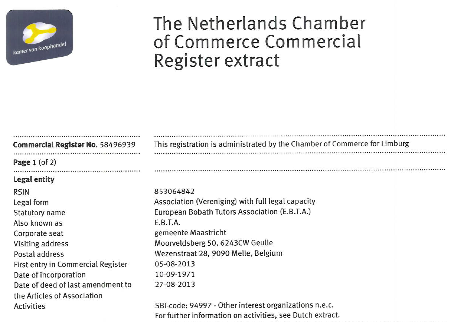
3. Legal status
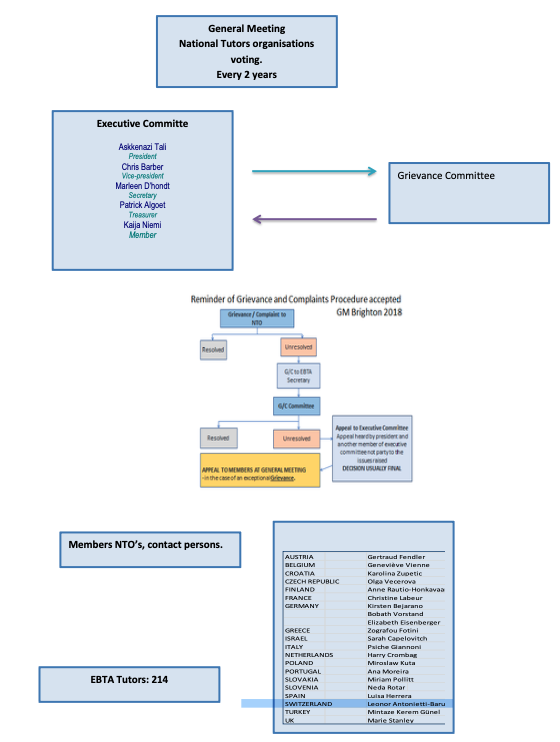
4. Organigram
5. Aims and activities: Current Executive
We the Executive Committee for EBTA, have therefore set the following priorities and actions for our term of office (2018 – 2020):
- To maintain the integrity of the Bobath Concept and develop it, in accordance with evolving scientific advances.
- We aim to provide regular meetings/interaction/dialogue between Tutors from different NTOs e.g.bi- annual congress, workshops, working parties, topic specific courses
- We aim to encourage co-teaching by Tutors from different NTOs
- We will investigate the possibility of providing a program of specialist courses for tutors to develop their skills to higher levels to enhance their teaching.
- To strengthen the “Bobath Community” within Europe
- An Electronic Stamp for the issuing and recording of certificates issued on EBTA recognised courses will be established.
- A central Database of Bobath Tutors and Bobath trained therapists will be established and maintained
- Regular communication will take place between the Executive Committee and all NTOs and Bobath Trained Therapists
- To encourage joint working between teaching teams within a country
- i.e., to have one representative NTO in any one country
- To review the role of the Contact person
- So that the Contact Person is seen as the “voice of the NTO”. This will support effective and timely communication between parties, helping to move processes forwards with minimal delay.
- We will develop a “Handbook” for contact persons
- We will review the Grievance Policy to streamline this process and aid Contact People, and indeed all Tutors, in their work
- To begin to review the Articles of the Association
- These have been in place for many years and require review and updating to incorporate changes in policy as well as developments within the organisation and society as a whole.
- To begin to review the content of courses – and how they are written
- We will engage in a process of interaction with NTOs to ensure there is uniformity across EBTA course and that up to date and current terminology and frameworks are used, that will make course content universally accessible in different environments (NTOs, Universities, etc.)
The EBTA Executive Committee
Tali Ashkenazi, Liliana Klimont, Patrick Algoet, Kaija Neimi, Christine Barber & Heather Holgate
April 2019
6. Future Development
1) Strengthen quality status of the organisation: Qfor/Trademark

2) Further digitalising data of courses, tutors, Bobath-therapists.

3) Course for ST international. (September 2022,Gent).
4)Make course content universally accessible in different environments (NTOs, Universities, etc.) throughout Europe.
